By Jordan Rasmussen, former staff member
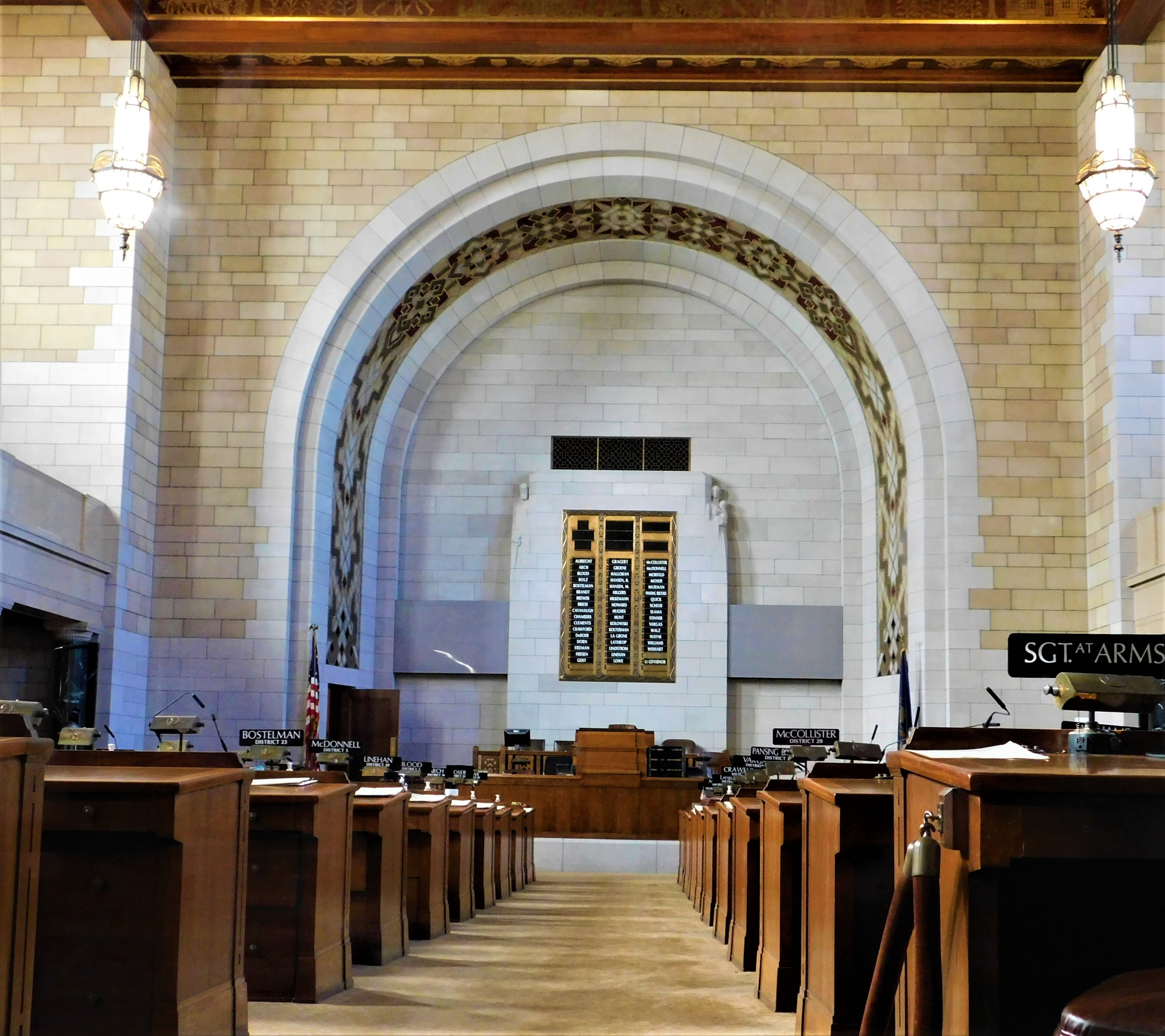
Today is day 22 of the Nebraska Legislative session. We have made it more than a third of the way through the “short,” 60 day session. The Legislature is tentatively scheduled to adjourn on April 23, 2020. The 482 new bills introduced during the second year of the biennium will be heard before one of 14 standing committees between now and Feb. 27.
Last week, the Center joined Sen. Tom Brandt of Plymouth at a hearing on LB 996, which will create the Broadband Data Improvement Program. A continuation of our broadband mapping efforts to ensure accuracy and access to service, this program will make sure the state is able to fully access federal broadband grant programs by complying with data verification requirements set forth by the Federal Communications Commission.
Along with our staff, three Center supporters testified in-person during the hearing, including Mike Tabbert, who also authored an op-ed on the topic, which appeared in the Lincoln Journal Star. An additional nine Center advocates submitted letters of support on the bill. The legislation remains in committee.
We encourage and invite you to do the same and take action on the following bills that will be heard this week.
Bills to watch this week:
LB 1040 (Vargas) Support → Provide for a state food insecurity nutrition incentive grant program.
Hearing scheduled for Feb 11 before the Agriculture Committee.
LB 1073 (DeBoer) Support → Create the School Financing Review Commission, add basic funding aid, and change adjusted valuations, the local effort rate, and certification dates.
Hearing scheduled for Feb. 11 before the Education Committee.
LB 1116 (Morfeld) Support → Adopt the New School Construction and Water Access Act.
Hearing scheduled for Feb. 11 before the Urban Affairs Committee.
Center for Rural Affairs legislation.
LB 773 (Williams) Support → Appropriate funds for the Rural Workforce Housing Investment Fund.
Hearing scheduled for Feb. 12 before the Appropriations Committee.
LB 1207 (McCollister) Support → Adopt the Redistricting Act.
Hearing scheduled for Feb 12 before the Executive Board.
LB 933 (Crawford) Support → Change provisions relating to discontinuance of utility service.
Hearing scheduled for Feb. 13 before the Natural Resources Committee.
Read more about these and other bills we are watching below. *New developments are italicized and bolded.
Budget and tax
LB 974 (Revenue Committee) Oppose → Change taxation and school funding provisions.
Introduced by the Revenue Committee, LB 974 stands as a revised property tax relief/school funding bill. As outlined prior to the hearing, the bill would use $405 million in projected revenue surpluses over three years, but with a cost of more than $535 million.
The bill would also lower the taxable value of agricultural land by 20 percent over two years—both in and out of the school funding formula—for school taxing purposes. This would also be replicated for residential and commercial property, at a reduced rate of 15 percent over three years. Replacing some of the funds lost, foundation aid up to 15 percent of state net sales and income taxes would be allocated on a per-student basis to provide each school with up to 15 percent of basic funding. Foundation aid would be graduated from 5 percent in year one, to 10 percent in year two, and 15 percent in year three and beyond. Significant changes would also be made to the way in which schools would be able to spend, including limiting school spending growth to the consumer price index, reducing the building fund from 14 to 6 cents and a loss in unused budget authority.
This upturning of the state’s education formula and the unsustainable revenue sources would create further instability for schools and do little to address the structural issues of Nebraska’s property tax-school funding issue.
Referred to the Revenue Committee. Hearing held Jan. 22. The Center for Rural Affairs testified in opposition.
LB 1073 (DeBoer) Support → Create the School Financing Review Commission, add basic funding aid, and change adjusted valuations, the local effort rate, and certification dates.
LB 1073 offers a means to reduce the state’s reliance on property tax for school funding while also establishing the School Financing Review Commission to conduct an in-depth review of financing K-12 public schools and the current school funding model, to be reported upon no later than fall 2021. Three mechanisms will be used to create a reduction in the state’s reliance on property taxes for the funding of schools: basic funding aid, lowering of agricultural land valuations in the current school funding formula, and a reduction of the location effort rate. Under the bill, all school districts would receive 7.5 percent of basic funding as outlined in the Tax Equity and Educational Opportunities Act (TEEOSA), which will benefit non-equalized schools while not harming equalized districts. Further increasing equalization aid to districts, especially those with large tracts of agricultural land, LB 1073 would reduce ag-land valuations from 75 percent to 52 percent within the TEEOSA formula—effectively lowering the available resources side of the formula. Moreover, the bill would lower the local effort rate from $1 to 99 cents, six cents below the maximum level, increasing state aid for equalized school districts. No pay for is outlined in the legislation.
Referred to the Education Committee. Hearing scheduled for Feb. 11.
Economic and community development
LB 879 (Geist) Oppose → Eliminate funding for the Nebraska Advantage Microenterprise Tax Credit Act and change the termination date for applications.
LB 879 would bring an early sunset to the Nebraska Advantage Microenterprise Tax Credit and redirect the roughly $2 million in funds to the Business Innovation Act under the Department of Economic Development. The Microenterprise Tax Credit, established in 2005, provides a 20-percent refundable income tax credit up to $10,000 to businesses with five or fewer employees, based on designated investments in their business. This tax credit has been a critical asset to rural and small business owners who are not eligible for larger tax credit programs.
Referred to Revenue Committee. Hearing held Jan. 23. Center for Rural Affairs testified in opposition. Center board members and supporters authored and submitted opposition letters of testimony.
See our op-ed that appeared in the Lincoln Journal Star
LB 996 (Brandt) Support → Create the Broadband Data Improvement Program.
This legislation, drafted by the Center in partnership with Sen. Brandt’s office, would create the Broadband Data Improvement Program. Passage of this bill will help ensure the state is able to fully access federal broadband grant programs by complying with data verification requirements set forth by the Federal Communications Commission. Should no federal guidelines be established for crowdsourcing data to better complete Nebraska’s broadband map, the Public Service Commission would create a crowdsourcing program, promote the program and allow for feedback on inaccuracies on federal broadband data. This legislation was brought forth as a result of Center constituents expressing concerns about inaccuracies in broadband map data and lack of service access.
Referred to the Transportation and Telecommunications Committee. Hearing held Feb. 3. Center for Rural Affairs testified in support. Three Center supporters testified in person and nine submitted letters of support.
Center for Rural Affairs legislation.
LB 773 (Williams) Support → Appropriate funds for the Rural Workforce Housing Investment Fund.
This bill would appropriate $10 million from the General Fund to the Department of Economic Development for fiscal year 2020-21 for the Rural Workforce Housing Investment Fund. This fund has supported workforce housing projects in communities across the state since it was enacted in 2017.
Referred to the Appropriations Committee. Hearing scheduled for Feb. 12.
LB 992 (Friesen) Support → Adopt the Broadband Internet Service Infrastructure Act and provide for certain broadband and Internet-related services.
Like LB 996, this bill seeks to implement elements of the Rural Broadband Task Force report released in late 2019. This would be achieved by allowing broadband providers to utilize electric utility easements in order to expand infrastructure. The bill would also create the position of a state broadband coordinator to encourage county-based solutions to broadband development and explore the creation of cooperatives in underserved areas of the state. It would also require the Nebraska Library Commission to employ regional technicians in order to assist public libraries with digital training and E-Rate filings. Finally, the bill would establish a separate fund in order to support the construction of fiber optic networks for public libraries across the state.
Referred to the Transportation and Telecommunications Committee. Hearing held Feb. 3. Prioritized by the Transportation and Telecommunications Committee.
LB 1003 (Walz) Watch → Provide annexation powers to cities of the second class and villages for relocation due to catastrophic flooding.
In the wake of the 2019 floods, some small towns were devastated and residents were forced to consider the physical relocation of their community. Yet, the current state statute does not allow for this relocation. LB 1003 would allow second class cities or villages, with a vote of the mayor or chairperson and two-thirds of the city council or village board, by ordinance, to annex land for the purpose of relocating part or all of the city and village that was damaged by catastrophic flooding.This authority would not allow for the annexation of any urban or suburban land and land annexed would need to be redeveloped as a community within five years.
Referred to the Urban Affairs Committee. Hearing scheduled Feb. 18.
LB 1214 (Friesen) Support → Adopt the Rural Economic Development Grant Act.
This bill creates the Rural Economic Development Grant Program to provide assistance grants to businesses located in micropolitan areas that are not eligible for the state's primary business incentive (i.e. Nebraska Advantage or ImagiNE Act.) Beyond these eligibility requirements, the existing or start-up business would need to create new jobs or make a new investment in a micropolitan area or be a non-profit or political subdivision assisting businesses in a micropolitan area. The program would be administered by the Department of Economic Development and annually distribute grants equal to five percent of tax credits used in the previous tax year under the primary business incentive program.
Referred to the Revenue Committee.
LB 1216 (Vargas) Support → Adopt the H3 Rural Renewal Award Act.
This bill would create the H3 Rural Renewal Act to help attract and keep high-wage, high-skill, and high-demand jobs and qualified workers in H3 jobs in rural areas of the state where there has been population loss and a shortage of a skilled labor force. Qualified employees, within five years of completing some post-secondary education and/or long-term job training, apprenticeship or certifications, while living in specified rural area, with wages exceeding specified wage metrics, would receive a monthly award proportional to their hourly wage. Moreover, the employee would be required to remain in a rural residence/community for two months for each month of participation in the program. Under this bill, $2 million would be appropriated from the General Fund in 2020, along with donations, to establish an endowment to create the H3 Rural Renewal Award Cash Fund. The program would terminate in 2031.
Referred to the Business and Labor Committee. Hearing scheduled for Feb 10.
LB 1049 (Bolz) Support → Provide for participation in federal Child Care Subsidy assistance as prescribed.
This legislation seeks to mitigate the child care subsidy cliff effect by increasing family eligibility for assistance from 125 percent of the federal poverty level (FPL) to 150 percent.. Increasing eligibility allows families to continue to receive subsidies for child care costs, while parents transition to better employment and wages. Funding would be drawn from carryover dollars within the Temporary Assistance for Needy Families program. LB 1049 also outlines reporting guidelines to measure the impact and effectiveness,.
Referred to the Health and Human Services Committee.
Energy and environment
LB 818 (Brewer) Oppose → Adjust the nameplate capacity tax for inflation.
This bill would adjust the nameplate capacity tax based upon the Consumer Price Index on an annual basis. The nameplate capacity tax is imposed on facilities that generate electricity through wind, solar, biomass, or landfill gas, currently at a rate of $3,518 per megawatt. There is concern that this additional and variable tax will be a detraction for developers and limit the ability of communities and counties to grow their tax base through renewable energy development.
Referred to the Revenue Committee. Hearing held Jan. 24. Center for Rural Affairs testified in opposition.
Resources: Fact sheet: Nebraska wind energy tax revenue
LB 823 (Brewer) Oppose → Provide for a special election prior to the exercise of eminent domain for transmission lines in certain circumstances.
Under LB 823, cities, villages, counties, municipalities, districts, or agencies as political subdivisions would be subject to a special election, should a public power district seek to use the eminent domain on a project funded by more than one-half by an out-of-state organization. These elections would create unnecessary costs and regulation.
Referred to the Judiciary Committee. Hearing held Jan. 22.
LB 899 (Hughes) Support → Provide certain powers to public power districts relating to biofuels and biofuel byproducts.
Under LB 899, public power districts would be allowed to develop, manufacture, use, purchase, and sell biofuel and biofuel products for the purpose of reducing greenhouse gas emissions.
Referred to the Natural Resources Committee. Hearing held Jan. 23.
LB 933 (Crawford) Support → Change provisions relating to discontinuance of utility service.
LB 933 would limit a public or private utility company from charging an excessive fee for disconnection or reconnection of service due to nonpayment by the customer. Moreover, the bill also would prohibit a utility from shutting off services for nonpayment for at least 60 days for a customer with a known illness or disability, as attested to by a doctor, physician’s assistant or advanced practice registered nurse. Service termination information should be posted for the public on the utility’s website or upon request by mail.
Referred to the Natural Resources Committee. Hearing scheduled for Feb. 13.
Food and agriculture
LB 28 (Kolterman) Support → Authorize damages for property taxes and special assessments paid on property lost through adverse possession.
The doctrine of adverse possession, which can result in landowners losing all or part of their land, has not been updated since 1869. The bill would make needed changes to this principle, allowing a landowner, who in good faith pays all of their property taxes, to be compensated for those payments when doing so is the fair and equitable outcome. Amendment (AM) 2281 alters the implementation date from 2020 to 2021. The impetus for this legislation came from Center supporters.
Referred to the Judiciary Committee. Hearing held Jan. 24, 2019. Center for Rural Affairs testified in support. Constituents testified in support. Carried over from 2019. Placed on General File with Amendment 2281.
Center for Rural Affairs legislation.
Resource: Adverse to change: a modern look at adverse possession
LB 255 (McCollister) Support → Change provisions relating to the Supplemental Nutrition Assistance Program (SNAP).
LB 255 would mitigate the SNAP cliff effect by increasing the gross income limit to 140 percent of the federal poverty level from the current 130 percent of federal poverty level. While retaining net income requirements, this legislation would allow families to maintain SNAP eligibility with incremental income increases.
Referred to the Health and Human Services Committee. Hearing held Feb. 7, 2019. Center for Rural Affairs submitted letter of support. Carried over from 2019. Placed on General File.
LB 972 (Brandt) Support → Change germination seed testing provisions under the Nebraska Seed Law.
LB 972 would extend the testing period for native flower and grass seed germination from 9 months to 15 months. This extended testing period accounts for the dormancy of native seeds and allows those who grow and sell native seedstock to reduce the number of testings required for the limited quantity of seeds they produce.
Referred to the Agriculture Committee. Hearing held Jan. 28.
LB 1039 (Cavanaugh) Support → Adopt the Hunger-Free Schools Act.
The Hunger-Free Schools Act, as outlined by LB 1039, would provide an eligible free breakfast and lunch for all students in Nebraska’s public schools participating in either the breakfast or lunch programs under the Child Nutrition Act of 1966. Schools would be required to maximize federal reimbursements for meals through the community eligibility provision if more than 62.1 percent of students are eligible for free or reduced lunch, with the Nebraska Department of Education offsetting costs for both schools that meet or fall outside of the community eligibility provision. The Act would be funded through the state’s general fund.
Referred to the Education Committee.
LB 1040 (Vargas) Support → Provide for a state food insecurity nutrition incentive grant program.
LB 1040 would give the Nebraska Department of Agriculture the authority to manage and expand the state’s Double Up Food Bucks program. The Double Up Food Bucks program doubles the value of SNAP dollars, when spent on fresh fruits and vegetables at qualifying farmers markets and grocery stores. This allows Nebraskans receiving federal food assistance to stretch their food dollars, while buying healthy foods grown in Nebraska and sold by local retailers. The expansion of the program would allow for growth into more rural markets across the state.
Referred to the Agriculture Committee. Hearing scheduled for Feb 11.
Good government
LB 809 (Wayne) Support → Adopt 2018 Uniform Plumbing Code standards.
Passage of LB 809 would allow for the updating of plumbing codes in cities and villages without specified ordinances or resolutions, through the state adoption of the 2018 Uniform Plumbing Code as designated by the American National Standards Institute as an American National Standard. This legislation would codify the current national standards and practices for plumbing and ensure the health and wellbeing of residents.
Referred to the Urban Affairs Committee. Hearing held Jan. 28. Placed on General File.
LB 1207 (McCollister) Support → Adopt the Redistricting Act.
Following the 2020 Census, legislative, judicial and other districts of elected or appointed representation will need to be redrawn in Nebraska. LB 1207 seeks to establish procedures for drawing these districts in a manner in which there is equality in population, without regard for political affiliation or previous voting data and with consideration of county and community boundary lines. The bill also sets forth the process for the adoption of the completed maps by the legislature.
Referred to the Executive Board. Hearing scheduled for Feb 12.
Health care
LB 1116 (Morfeld) Support → Adopt the New School Construction and Water Access Act.
The school buildings where Nebraska students spend much of their day can help shape habits and curb our state’s levels of obesity by increasing access to and the consumption of water by students.
Right now, schools are asked to follow two conflicting requirements when planning for new school construction. LB 1116 sets one standard. The bill would also ensure at least one drinking fountain be installed on each floor of a new school building, a practice widely accepted among Nebraska schools. The bill only applies to new school construction. Moreover, the Act will require water fountains to be regularly cleaned and maintained, in order to dispense clean drinking water. These small actions will help form the lifelong behaviors that will make for a healthier Nebraska.
Referred to the Urban Affairs Committee. Hearing scheduled for Feb. 11.
Center for Rural Affairs Legislation.
Resource: Addressing obesity through school water access
LB 810 (McCollister) Support → Impose sales tax on bottled water, candy, and soft drinks.
Complimenting our efforts to mitigate the long-term impacts of obesity on Nebraskans, LB 810 would impose standard sales and use taxes on the purchase of candy, soft drinks, and bottled water. Funds from this tax would be deposited in the Nebraska Health Care Cash fund, which is utilized for health-care-related expenditures.
Referred to the Revenue Committee. Hearing held Jan. 30. Center for Rural Affairs submitted a letter of support.
LB 815 (Morfeld) Support → Prohibit certain section 1115 waivers under the Medical Assistance Act.
LB 815 adds language to the law enacted through the passage of Medicaid expansion. This bill would restrict the Department of Health and Human Services from pursuing, applying for or implementing a demonstration waiver under section 1115 of the Social Security Act, which would modify eligibility for medical assistance.
Referred to the Health and Human Services Committee.
LB 877 (Walz) Support → State intent regarding appropriations for aging and disability resource centers.
Nebraska’s Aging and Disability Resource Centers (ADRC), housed within local Area Agencies on Aging, serve as a resource navigation hub for elders and Nebraskans with disabilities and their families. LB 877 would provide funding to the ADRCs to expand collaborations and marketing efforts.
Referred to the Appropriations Committee. Hearing held Feb. 10. Center for Rural of Affairs submitted a letter of support.
LB 932 (Wishart) Support → Require expansion of the medical assistance program as prescribed, LB 932 seeks to codify the start date for the expansion of Medicaid for those eligible on or before Oct. 1, 2020.
Passage of this legislation would hinder the Department of Health and Human Services from further delaying the implementation of Medicaid expansion, which was passed into law in 2018.
Referred to the Health and Human Services Committee. Hearing held Jan 29. Center for Rural Affairs testified in support.
Are you interested in any of these bills? Would you like to share your support, concerns, insights, or opposition by testifying in person or through a written letter of testimony? Center staff are here to walk you through and assist you through the process—from draft to delivery.
Advocacy tip
Unable to testify in person? Check out our blog that outlines the process of submitting a letter of testimony for the official hearing record.